How to Win Tic-Tac-Toe Every Time (and Never Lose)
Short answer
You cannot win tic-tac-toe every time against a perfect player, because perfect play by both sides always ends in a draw. But you can make sure you never lose, and you will win often against most people. Go first and take a corner, always win if you can, always block your opponent's two-in-a-row, and try to create a fork: one move that makes two winning threats at once. Practise against the unbeatable computer in our free Tic-Tac-Toe game.
Tic-tac-toe looks like a game for little kids, and it is a great first strategy game. It is also a neat puzzle: there are only nine squares, so every position can be worked out. Computer scientists solved it long ago. The result is that if both players make no mistakes, the game is always a draw. So "winning every time" really means two things: never losing, and grabbing the win whenever your opponent slips. Here is how to do both.
The three rules to check on every move
Before you place a mark, run through this list in order. It sounds simple, but most lost games come from skipping it.
- Can I win right now? If you have two in a row with the third square empty, take it.
- Must I block? If your opponent has two in a row with the third square empty, block it immediately.
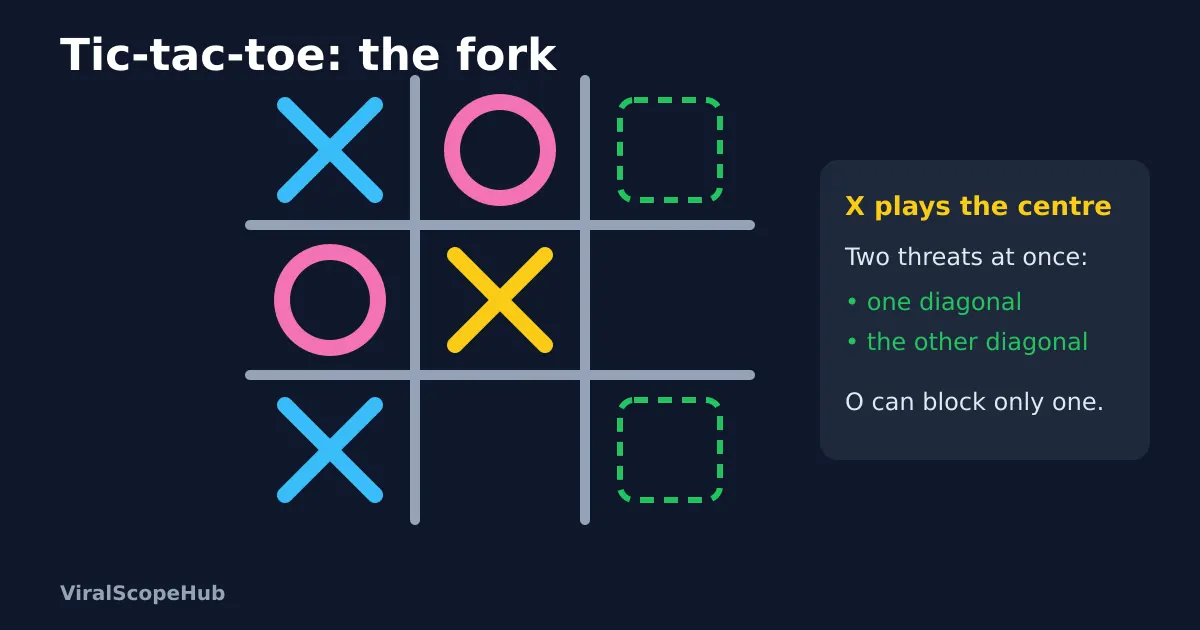
- Can I make a fork? Look for a square that gives you two different lines with two marks each. Your opponent can only block one, so you win next turn.
If none of these apply, pick the best open square: centre first, then a corner, then an edge (the middle square of a side).
Best first move: take a corner
When you play X and move first, the centre and the corners are both safe. Corners give beginners the most chances to go wrong, so they are the best practical choice. Edges are the weakest opening because they touch only two lines instead of three or four.
| Square | Lines it is part of | Rating |
|---|---|---|
| Centre | 4 (row, column, both diagonals) | Strong |
| Corner | 3 (row, column, one diagonal) | Strong, sets traps |
| Edge | 2 (row, column) | Weakest |
The corner trap: a worked example
Number the squares 1 to 9 like a phone keypad, top-left to bottom-right. You are X.
- X takes corner 1.
- If O answers anywhere except the centre (5), you can usually force a win. Say O plays edge 2.
- X takes corner 7. Now X threatens 1-4-7, so O must block at 4.
- X takes 5 (centre). Now X threatens both 7-5-3 and 1-5-9. That is a fork.
- O can block only one. X wins on the next move.
If O replies to your corner with the opposite corner or an edge, similar forks appear. The only reply that holds the draw is the centre, followed by careful blocking. Try this exact sequence against the "easy computer" mode in our game and watch it work.
How to never lose when you go second
Playing O is about defence. Use these replies:
- X takes a corner: you take the centre. Taking anything else lets X build the trap above.
- X takes the centre: you take a corner. An edge reply can lose.
- X takes an edge: take the centre or a square next to their mark.
One classic mistake: X has two opposite corners (say 1 and 9) and you hold the centre. Do not take another corner, because X can fork. Take an edge instead, which forces X to block you and kills the trap.
Why perfect play is always a draw
There are only 255,168 possible games of tic-tac-toe, and far fewer really different positions once you count rotations and mirror images. That is small enough for a computer to check every possibility. Our unbeatable mode uses a method called minimax: it looks at every future move, assumes you will play your best, and picks the move with the best guaranteed result. Against it, the best you can do is a draw. If you manage that every time, you have truly learned the game.
Practice plan for kids and beginners
- Play five games against the easy computer as X, always opening in a corner. Aim to win with a fork.
- Play five games as O against the easy computer, using the defence rules above.
- Switch to the unbeatable computer and aim for ten draws in a row.
- Play a friend in two-player mode and explain the three rules to them as you go.
Tic-tac-toe is a perfect warm-up for bigger strategy games. When forks start to feel natural, move on to chess, checkers and four in a row, where the same "make two threats at once" idea wins games. For more ideas, see our list of free online games with no download, our brain games and skill tests, and the guide to kid-safe online games. Puzzle fans can also learn how to solve Sudoku, and students can find exam help on our exam guides and study pages.
VSH take: The fork is the one idea worth remembering. Once you see a single move that makes two threats, you will start spotting it in chess, checkers and even card games. And when you can hold our unbeatable computer to a draw every time, you have officially "solved" tic-tac-toe yourself.
Frequently asked questions
Can you always win tic-tac-toe?
No. If both players play perfectly, the game is always a draw. You can always avoid losing, and you will often win against players who miss forks.
What is the best first move in tic-tac-toe?
A corner or the centre. Corners set the most traps for beginners, while edges are the weakest opening.
What is a fork in tic-tac-toe?
A move that creates two lines with two of your marks each. Your opponent can only block one, so you win on your next turn.
How do I stop losing when I go second?
If X opens in a corner, take the centre. If X opens in the centre, take a corner. Then always block two-in-a-row.
Is the computer in your game really unbeatable?
Yes, in unbeatable mode it uses the minimax method and never loses. The best possible result against it is a draw.