World · Paris · Elections hub
Euclid space telescope discovers its first new comet
In brief
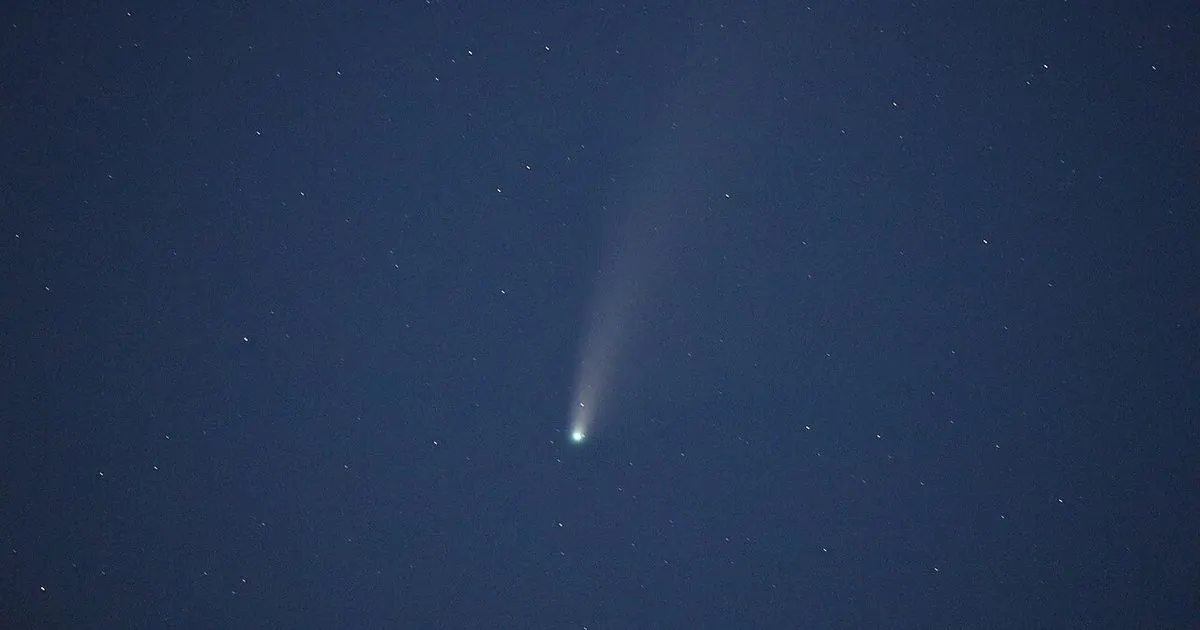
The European Space Agency (ESA) has announced that its Euclid space telescope discovered a comet nobody had seen before. Named C/2026 S1 (Euclid), it showed up in images taken between Sept. 16 and 24 and was confirmed as a new comet by the Minor Planet Center on Oct. 8.
How a galaxy-mapping telescope found a comet
Euclid was built to photograph billions of distant galaxies, not to chase objects inside our own solar system. It even steers away from the band of sky where most asteroids and comets travel, because their dust adds glare. ESA says that makes this find unusual. Mikko Pöntinen, a researcher at the University of Helsinki, spotted the comet with software he wrote to flag moving objects in Euclid's pictures. The program picked out a streak, and he then tracked it down in five separate sets of images. A fuzzy cloud around it showed it was an active comet shedding dust and gas.
Where the comet is
According to ESA, the comet is roughly 1.3 billion kilometres from Earth, about the distance between the orbits of Jupiter and Saturn. Unlike the planets, it is not travelling in the flat plane of the solar system. It is currently far "above" the Sun, on a very long orbit. The Euclid Consortium says the comet comes from the distant Oort Cloud and will not return for hundreds of thousands of years.
Can you see it?
No, not with a backyard telescope. Public orbit tables list it at around magnitude 20.7, hundreds of thousands of times fainter than the dimmest stars you can see without a telescope, and well beyond backyard equipment. It is a target for large research telescopes only.
VSH take: this find came from a few days of images and one researcher's own software, which is a good reminder that big science projects often turn up surprises on the side. For something you can actually see this week, the Orionid meteor shower peaks on the nights of Oct. 21 and 22. Our Orionids guide has the times, and the moon phase tool shows how dark your sky will be.
Why it matters
ESA says the quick detection and confirmation show Euclid can catch new comets while they are still far from the Sun. That could one day help find a target for its planned Comet Interceptor mission, although this comet is not suitable for it.
People also ask
What is the new comet called?
Its official name is C/2026 S1 (Euclid). The C means it is not a periodic comet with a short, regular orbit, and the name credits the telescope that found it.
Will the Euclid comet be visible from Earth?
Not to the naked eye or small telescopes. It is about 1.3 billion km away and around magnitude 20.7, so only large research telescopes can pick it up.
Related free tools: sunrise-sunset-moon-phase, solar-system-explorer
Sources
- European Space Agency: Euclid discovers new comet
- Euclid Consortium: Meet Euclid's first comet discovery: C/2026 S1 (Euclid)
- Phys.org: Euclid discovers its first new comet 810 million miles from Earth
Every ViralScopeHub news item is an original summary written in our own words. We link to the original reporting so you can read the full story from the publisher.