What Are UTM Parameters? A Plain-English Guide to Tracking Links
Short answer
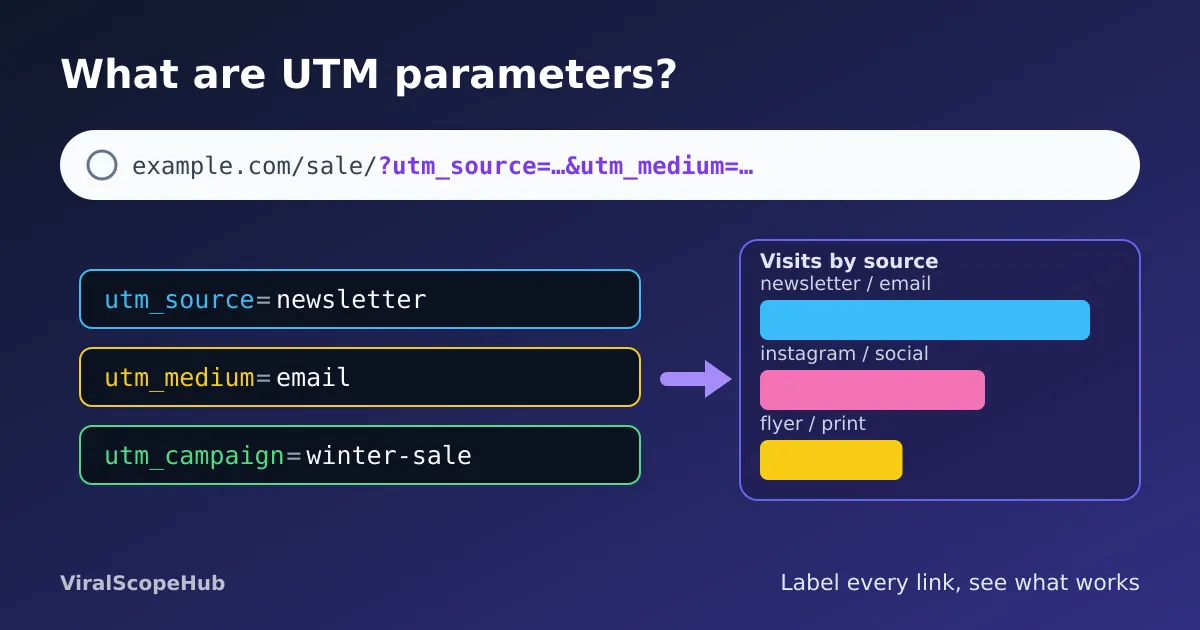
UTM parameters are small labels added to the end of a link, such as utm_source=newsletter, that tell analytics tools like Google Analytics where a visitor came from. The page itself does not change; the tags simply ride along in the address. Always use at least source, medium and campaign, keep everything lowercase, and build links with our free UTM Link Builder so nothing is mistyped.
Imagine you share the same web page in an email newsletter, an Instagram bio and a printed flyer. A week later your analytics shows 300 new visitors, but which of the three actually worked? Without extra information, a lot of that traffic lands in a vague bucket like "direct" or "referral". UTM parameters fix this. They are a simple, free way to label every link you share so the results are easy to read later.
The name comes from Urchin Tracking Module. Urchin was a web analytics company that Google bought in 2005, and its software became the base of Google Analytics. The tags kept the old name, and today almost every analytics and advertising tool understands them.
What a UTM link looks like
Here is a normal link followed by the same link with UTM tags:
https://example.com/winter-sale/
https://example.com/winter-sale/?utm_source=newsletter&utm_medium=email&utm_campaign=winter-sale
Everything after the question mark is the query string. Each tag is a name and a value joined by an equals sign, and tags are separated by an ampersand (&). The order does not matter. When someone clicks the link, the page opens exactly as usual, while your analytics reads the tags and records that this visit came from the newsletter, by email, as part of the winter sale.
The five main UTM tags
| Tag | Answers the question | Example values |
|---|---|---|
utm_source | Who sent the visitor? | newsletter, google, facebook, flyer |
utm_medium | What type of channel? | email, cpc, social, print, referral |
utm_campaign | Which promotion or project? | winter-sale, app-launch, diwali-2026 |
utm_term | Which paid keyword? | free-pdf-merger |
utm_content | Which link or creative? | top-button, footer-link, video-ad-b |
Google's own help page says you should always include source, medium and campaign. Term and content are optional. Content is especially useful for simple A/B tests: if an email has two buttons that point to the same page, give them different utm_content values and you will see which one people clicked more.
Google Analytics 4 also accepts a few newer tags, such as utm_id (a campaign ID) and utm_source_platform. Most small sites, bloggers and shops never need them, but they are worth knowing if you work with large ad accounts.
Naming rules that save you headaches
UTM values are case sensitive. To Google Analytics, Facebook and facebook are two different sources, and your report will split into two rows. A few habits keep the data clean:
- Use lowercase everywhere. It is the simplest rule and prevents most duplicates.
- Pick one separator. Use hyphens or underscores, not both.
winter-saleandwinter_salealso count as different campaigns. - Keep a short naming list. Decide once that email is always
emailand paid search is alwayscpc, then stick to it. A shared spreadsheet works well for teams. - Avoid spaces and odd symbols. Spaces turn into
%20or plus signs, which looks messy and can break when people copy links. Our URL Encoder / Decoder shows exactly how a value will be encoded, and the Slug Generator turns a phrase into a clean hyphenated value. - Make values descriptive.
oct-newsletteris clearer thannl2when you look back in six months.
Where UTM links help most
- Email newsletters: tag every link so you can compare issues and buttons.
- Social media bios and posts: platforms often hide where clicks come from, especially from apps. A tagged link removes the guesswork.
- Print and offline: put a tagged link inside a QR code on a flyer, poster or product box with our QR Code Generator. Now offline scans show up in your reports as
utm_medium=print. - Partners and guest posts: give each partner its own
utm_sourceto see who sends real visitors. - Paid ads: many ad platforms can add tags automatically, but manual UTM tags are still common on networks that do not connect directly to your analytics.
Common mistakes to avoid
- Tagging internal links. Never put UTM tags on links from one page of your own site to another. Analytics may treat the click as a brand-new visit from that "source", which splits sessions and ruins your numbers.
- Two question marks. If the page address already contains a
?, the UTM tags must start with&, not a second?. A builder handles this for you. - Leaving out the medium. Missing tags show up as "(not set)" in reports, which tells you nothing.
- Personal data in tags. Do not put names, email addresses or phone numbers in UTM values. They end up stored in analytics reports, which is a privacy problem and breaks most analytics terms of service.
- Very long, ugly links. Long tagged links look spammy when pasted in chats. A QR code or a short, tidy campaign name helps.
Build a UTM link in four steps
- Open our free UTM Link Builder. It runs in your browser, so nothing you type is uploaded.
- Paste the page address, for example
https://example.com/winter-sale/. - Fill in source, medium and campaign in lowercase. Add term or content only if you need them. The finished link updates as you type.
- Click Copy link and use it in your email, post or QR code. After a few days, check the Traffic acquisition report in Google Analytics (Session source / medium) to see the results.
VSH take: UTM tags are one of the cheapest upgrades a small website, YouTube channel or local business can make. Ten seconds per link gives you real answers about what works, so you can spend your time, and any ad budget, on the channels that actually bring people in. The hard part is not the tags; it is staying consistent, so write your naming rules down on day one.
Planning a trip or studying for an exam? Our flight deals hub, exam guides and study tools are free too.
This guide is general information for website owners, students and small businesses. ViralScopeHub is an independent site and is not affiliated with Google, Google Analytics or any platform mentioned here.
Frequently asked questions
What does UTM stand for?
Urchin Tracking Module. Urchin was a web analytics company bought by Google in 2005, and its software became the base of Google Analytics.
Which UTM parameters are required?
Google recommends always using utm_source, utm_medium and utm_campaign. utm_term and utm_content are optional extras for keywords and for telling links or ads apart.
Do UTM parameters affect SEO?
Not directly. They do not change the page content. Use them on links you share outside your site, never on internal links, and keep a canonical tag on your pages so search engines index the clean address.
Are UTM parameters case sensitive?
Yes. Facebook and facebook are recorded as two different sources, so it is best to write every value in lowercase.
Can I put UTM links in a QR code?
Yes. Build the tagged link first, then turn it into a QR code. Scans from flyers or posters will then appear in your analytics under the medium you chose, such as print.
How do I create a UTM link for free?
Use our free UTM Link Builder: paste your page address, add source, medium and campaign, then copy the finished link.