Technology · Edwards, California, USA · Elections hub
NASA's quiet supersonic X-59 gets a new pilot at the controls, reaching Mach 1.4 over the Mojave
In brief
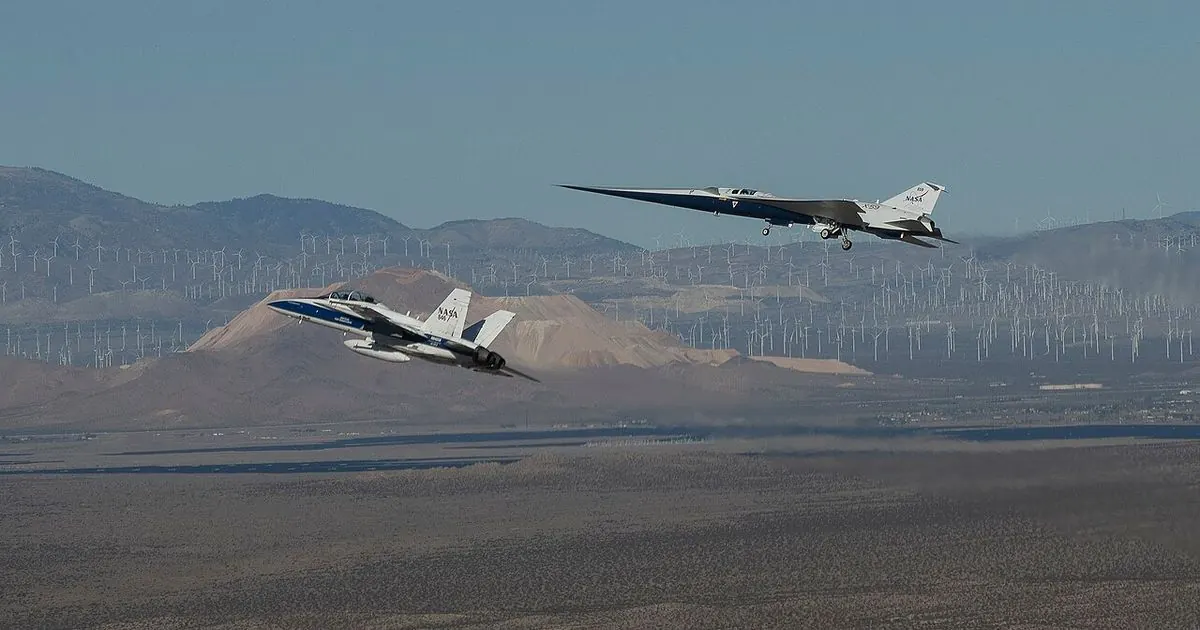
NASA test pilot Mike Lippert made his first flight in the X-59 quiet supersonic research aircraft on October 21, 2026, taking off from NASA's Armstrong Flight Research Center in Edwards, California, and landing an hour later. He reached Mach 1.4, about 1.4 times the speed of sound, at 55,000 feet. The flight followed scheduled maintenance and a systems review after the jet's busiest stretch of testing so far, six flights in three days in September.
Who flew and what happened
Lippert has flown high-performance aircraft for nearly 11 years, but this was his first time in an X-plane. NASA says he spent months preparing: a first engine run in August, long hours in the simulator, and training alongside fellow NASA test pilots Nils Larson and Jim "Clue" Less. During the hour-long flight he flew a series of manoeuvres to check how the aircraft handles while engineers on the ground watched its systems. "For as long as I can remember, I've dreamt of doing exactly what I got to do today," he said in NASA's update.
Why the X-59 matters
Supersonic passenger flights over land have been banned in the United States and many other countries for decades because of the loud sonic boom created when a plane breaks the sound barrier. The X-59, built by Lockheed Martin Skunk Works for NASA's Quesst mission, is shaped to turn that boom into a much softer "thump". Its very long, thin nose and its engine mounted on top of the fuselage keep the shock waves that form around the plane from merging into the two sharp bangs people on the ground normally hear.
The aircraft first flew in 2025, and by mid-October 2026 NASA was describing it as having completed 38 flights. The next big step is the reason the project exists: NASA plans to fly the X-59 over selected communities and ask residents how loud the thumps seemed, then share that data with US and international regulators who will decide whether a new, data-based noise limit could allow quiet supersonic travel over land. The Quesst mission is scheduled to run through 2029.
VSH take: it is easy to forget how much of aviation progress comes down to patient, step-by-step testing like this. If the community surveys go well, the payoff could be much shorter long-distance flights one day, but that depends on regulators, airlines and new aircraft that do not exist yet. Curious how much faster? Try converting airliner and supersonic speeds between mph and km/h with our unit converter, or see how many hours you would save on a route with the time calculator. You can also browse current fares on our flights page.
This is our own summary of NASA's Quesst blog posts and mission page. ViralScopeHub is not affiliated with NASA or Lockheed Martin.
Why it matters
The X-59 is the test aircraft meant to show that supersonic jets can fly over land without disturbing booms, a step that could eventually change long-distance travel.
People also ask
What is the X-59?
A one-of-a-kind NASA research jet built by Lockheed Martin for the Quesst mission. Its shape is designed to make a quiet sonic thump instead of a loud boom when flying faster than sound.
How fast did the X-59 fly on October 21, 2026?
NASA says test pilot Mike Lippert reached Mach 1.4, about 1.4 times the speed of sound, at an altitude of 55,000 feet.
Will I be able to fly on a quiet supersonic plane soon?
Not yet. NASA first needs to fly the X-59 over communities and share people's reactions with regulators, who would then have to change the rules before airlines could offer such flights.
Related free tools: Unit Converter, Time Calculator
Sources
- NASA: NASA's Mike Lippert Takes Controls of X-59 for First Time
- NASA: Diving into Maintenance with NASA's X-59
- NASA: Quesst mission page
Every ViralScopeHub news item is an original summary written in our own words. We link to the original reporting so you can read the full story from the publisher.