USA · Laurel, Maryland, USA · Elections hub
NASA's Dragonfly rotorcraft completes its first full simulated flight over Titan
In brief
NASA said on October 23, 2026, that its Dragonfly rotorcraft has completed the most complete test yet of its planned first flight on Saturn's moon Titan. The flight did not happen in the sky: it ran in real time on flight-like computers at the Johns Hopkins Applied Physics Laboratory (APL) in Laurel, Maryland, where Dragonfly is being built and tested. In the simulation, the rotorcraft separated from its protective backshell, scanned simulated sand dunes, picked a safe landing spot, circled back and touched down, using most of the systems it will need when it reaches Titan in 2034.
How the test worked
The team combined Dragonfly's flight software and avionics with simulated data from the sensors it will carry, including its new navigation cameras, inertial measurement units and lidar. A custom camera emulator rendered each Titan scene in roughly the 20 to 70 milliseconds the real cameras will take to capture a picture. "The cool thing about first flight is that it's our most challenging flight," said Zach Putnam, Dragonfly's mobility subsystem lead engineer at APL. "It uses every piece of flight sensor hardware on the lander."
Why it has to fly by itself
Titan is so far away that commands from Earth take far too long to arrive for anyone to steer Dragonfly live, so it must find safe ground and land on its own. Next, engineers plan to run the same first flight on Dragonfly's actual flight system, test other flight paths and deliberately add faults to check that it can react by itself. Dragonfly is scheduled to launch no earlier than 2028 on a six-year trip, then spend about three years hopping between sites to study Titan's chemistry, geology and atmosphere.
VSH take: A drone flying on another world sounds like science fiction, but NASA's Ingenuity helicopter already proved it can work on Mars. Titan is in some ways easier for flying: its air is thicker than Earth's and its gravity is weaker. The hard part is distance, which is why tests like this matter so much. It is a great one to share with kids. Test what you know with our space quiz, see the planet from orbit on Live Earth from space, or check today's sunrise and sunset times.
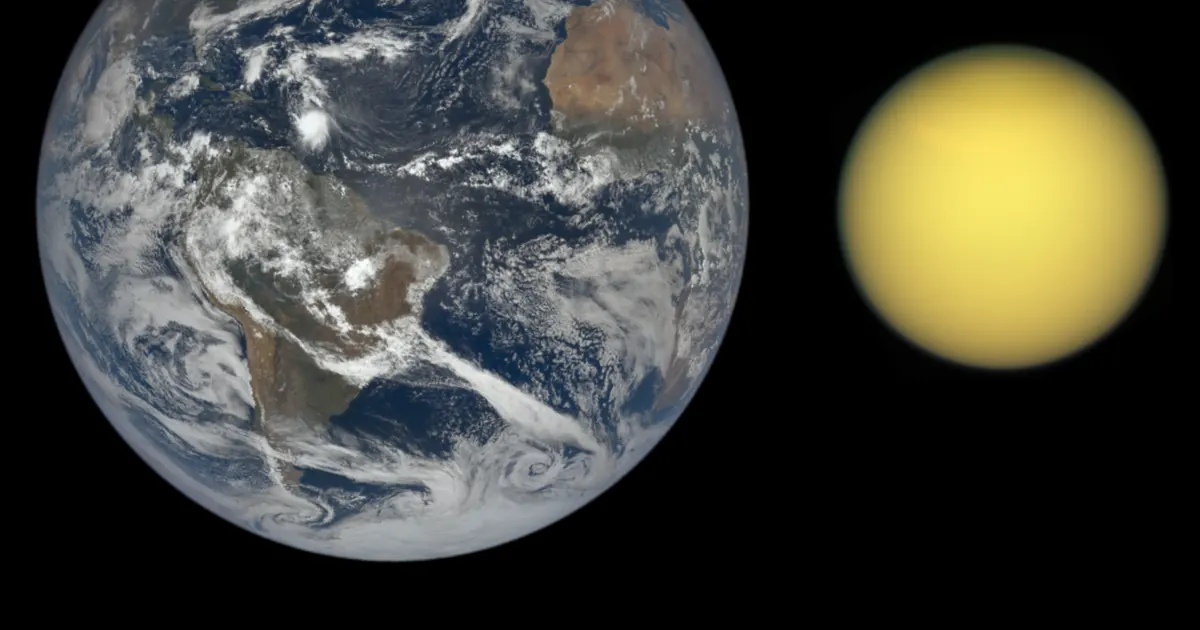
ViralScopeHub is an independent news summary site and is not affiliated with NASA or the Johns Hopkins Applied Physics Laboratory. The image shows Earth and Titan to scale, not the Dragonfly simulation.
Why it matters
Dragonfly will be NASA's first rotorcraft on an outer-planet moon, and it has to fly and land on its own because Titan is too far away to steer from Earth.
People also ask
What is NASA's Dragonfly?
Dragonfly is a car-sized rotorcraft lander NASA is building to fly between sites on Saturn's moon Titan and study its chemistry, geology and atmosphere.
Did Dragonfly actually fly?
Not yet. The 'first flight' ran in real time on flight-like computers at Johns Hopkins APL using simulated sensor data, the most complete test of it so far.
When will Dragonfly reach Titan?
It is scheduled to launch no earlier than 2028 and to arrive at Titan in 2034 after a six-year trip.
Related free tools: Sunrise & Sunset, World Clock
Sources
Every ViralScopeHub news item is an original summary written in our own words. We link to the original reporting so you can read the full story from the publisher.